Search This Blog

Showing posts with label art review. Show all posts

Saturday, January 12, 2008

Keith Edmier: The Fly, Farrah & Now An Exhibit At Bard College


Keith Edmier and Farrah Fawcett: Recasting Pygmalion

The most comprehensive exhibition to date of this celebrated American artist, Keith Edmier 1991–2007, is on view in the galleries of the Center for Curatorial Studies at Bard College, from Saturday, October 20, through Sunday, February 3, 2008.


above: keith edmier

A highlight of the exhibition is the CCS commission Bremen Towne, a full-scale recreation of Edmier’s childhood home. “Edmier’s work is always at the edge of the acceptable boundaries of artistic virtues and taste,” writes curator Tom Eccles, CCS Bard executive director, in the book that accompanies the exhibition.

Concurrently with Keith Edmier 1991–2007, the CCS Bard Hessel Museum presents, Exhibitionism: An Exhibition of Exhibitions of Works from the Marieluise Hessel Collection.

This new installation of the Hessel Collection, curated by White Columns director Matthew Higgs, presents a series of exhibitions in each of the 16 galleries in the newly inaugurated Hessel Museum.

Below are images from Bard College's press release (click to enlarge)


And below are pics and a review from the NY Times of this very exhibit:


From left, Artist Keith Edmier's "Beverly Edmier, 1967" (1998), "Sunflower" (1996), and "A Dozen Roses" (1998) are part of the exhibition at Bard's Center for Curatorial Studies.


"With a title like an epitaph, sculptures like wax museum effigies, and a full-scale 1970s ranch-house interior, as quiet as a chapel, at its center, this career retrospective of work by Mr. Edmier, an artist who has been exhibiting in New York since 1993 and who was included in the 2002 Whitney Biennial, is one of the more bizarre solo shows to come along in a while. In it, exacting craftsmanship has the chill of the mortician’s art. Period kitsch and personal recollection are inseparable. Memory is both a truth serum and embalming medium."
Read The Complete Review By Holland Cotter for the NY Times here.


Above: Keith building a replica of his childhood kitchen back in October, 2007

Above: the final installation as it appears in the show, jan. 2008

“Bremen Towne”
She stands like a guardian spirit near the front door of “Bremen Towne,” the full-scale reproduction of the interior of Mr. Edmier’s childhood home commissioned by Bard for the show. It looks like a tour de force of e-bay nostalgia shopping. But the artist, using family photographs and memories as cues, made or revamped almost everything in it — from kitchen appliances, to curtains, to a carved wood figure of a hooded monk that stands like a memento mori in the middle of the living room. Characteristically, in its reconstructed version, the monk is also a portrait of the artist’s father. Photo: Chris Kendall


Above:Installation view of “Bremen Towne” (2006-07), Photo: Chris Kendall

Mr. Edmier was born in Chicago in 1967 and grew up nearby in suburban Tinley Park. He was a formidable sculptor when he was barely into his teens, cooking up clay models for masks and prosthetic devices inspired by horror and monster films. During high school he made contact with special-effects makeup artists.

In 1985, Mr. Edmier moved to Los Angeles to work on films, among them David Cronenberg’s remake of “The Fly.” He also enrolled at California Institute of the Arts, where he had a formative immersion in the neo-conceptualist and appropriation art being grouped under the label of post-modernism. His stay there was short — a year — but it directed his career goals from popular film to art and prompted a relocation to New York City in 1990.


Above: “Beverly Edmier, 1967” (1998), Photo: Andy Keate

Above: detail of Beverly Edmier

The startling sculpture called “Beverly Edmier, 1967,” is another Madonna and Child image, one that takes Mr. Edmier even further back into his past. It’s a life-size figure, cast in translucent pink plastic, of his own pregnant mother carrying him as a fetus curled up in her transparent womb. Like much of Mr. Edmier’s art, it has many referential layers that connect it with larger histories.

Beverly’s seated pose echoes that of Abraham Lincoln, another Illinois resident, in the Lincoln Memorial. And she is dressed in a facsimile of the pink Chanel suit that Jacqueline Kennedy was wearing the day her husband was assassinated.

Keith's resin study for "Beverly" (below) was just auctioned off last month
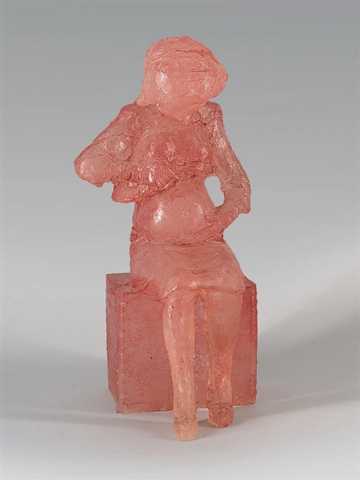
Keith Edmier, Beverly Edmier (study)


Artist
Keith Edmier
Title
Beverly Edmier (study)
Year
1998 -
Medium
acrylic on resin
Size
14 x 6.8 x 9.1 in. / 35.6 x 17.2 x 23.2 cm.
Edition
2/6
Sale Of
Christie's South Kensington: Thursday, December 13, 2007
[Lot 33]
Post War & Contemporary Art


Above: “Jill Peters” (1997), Keith Edmeir

“Jill Peters” (1997) is a full-length portrait of Mr. Edmier’s grade-school sweetheart as a virginal ghost of true loves past. Cast in snow-white polyvinyl, wearing white clothes and a luxuriant pale platinum wig, and smiling as she casts her eyes upward, she is a prepubescent idol with a Farrah Fawcett ’do, St. Jill of Perpetual Uplift. Humbert Humbert would have knelt at her Earth Shoes-clad feet.
Photo: Lamay Photo

He's Friends With Farrah...

In 1977, a pinup poster of the actress in a bathing suit was a national best seller; the pre-adolescent Mr. Edmier had one on his bedroom wall. In 1998, he introduced himself to his childhood muse.


above: Farrah and Keith working on their mutual sculptures of one another.

Before she had had any thoughts of acting, Ms. Fawcett had been an art student, specializing in sculpture, at the University of Texas in Austin. Mr. Edmier invited her to return to her initial avocation and collaborate with him on a project. She accepted and, working together in a California studio, they made nude portraits of each other.


Above: Detail of Keith Edmier's piece of Farrah from a memorial in a sculptural group called “Keith Edmier and Farrah Fawcett, 2000.”

above: backside of Keith's sculpture of Farrah.


Above: And this is Farrah's sculpture of Keith from the same sculptural grouping,
Photo: Lamay Photo

A book has been published by Rizzoli on their collaboration, Keith Edmier and Farrah Fawcett: Recasting Pygmalion:

Keith Edmier and Farah Fawcett
Written by Dave Hickey
Pub Date: December 2002


Buy the book by clicking on the link below:
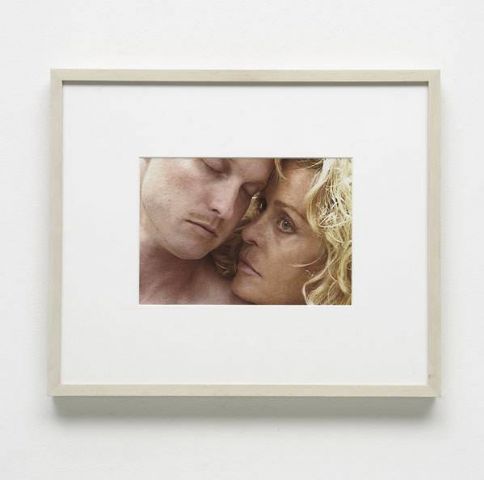


Keith Edmier, The space between you and me (collab w/Farah Fawcett)


Artist
Keith Edmier
Title
The space between you and me (collab w/Farah Fawcett)
Year
2000 - 2001
Medium
color coupler print, mntd
Size
7.5 x 10.7 in. / 19 x 27.3 cm.
Edition
9/50
Misc.
Signed
Sale Of
Phillips, de Pury & Company New York: Saturday, April 8, 2006
[Lot 260]
Saturday @ Phillips - Contemporary Art, 20-21st Century Design Art, Photographs, Jewelry

Read Rachel Taylor's profile of Mr. Edmier for Contemporary Magazine here.

“Keith Edmier 1991-2007” remains at the Center for Curatorial Studies, Bard College, Annandale-on-Hudson, N. Y., (845) 758-7598, through Feb. 3.

Wednesday, September 12, 2007

Mr. Rogers Neighborhood On LSD: The paintings of Amy Bennett

I inadvertently stumbled upon Amy Bennett's work the other day and boy, am I glad I did. Now a new fan, I'd love to share with you this woman's unique take on suburban landscapes.


Above: Dig, Amy Bennett 2007, oil

Below are some images of Amy Bennett's work. Done in oils, her works have a surreal and almost photographic quality, until one looks closer and sees both the darker narrative and the craft.

What looks like a set of dollhouse furniture is actually an oil painting telling a story of what at first glance looks like Mr. Rogers neighborhood, but upon closer inspection is a revealing glimpse of the human condition.

Below is both the artist's statement as well as an interview which will give you far more insight into Amy's work than my amateur observations.

While Amy also paints interiors, I am far more fond of her aerial paintings and her 'dollhouse' bisected homes which is what I've opted to share with you here.


Above: Property Line by Amy Bennett


Above: Losing It


Above: Paying Respects


Above:name unknown


Above: Everything Passes


Above: I Am Begging You


Above: Send Us A Signal by Amy Bennett

AMY BENNETT - ARTISTS' STATEMENT:
In 2002 I began a series of aerial view paintings of apartments. Inspired by short stories, and game boards, I created floor plans to relate the dramas of residences in close proximity. As reference for each painting, I made model apartments from foam core, and furnished them with dollhouse miniatures. Over the past year, I have incorporated perspective and worked from a more normative point of view. My current series of paintings depict one family living in a modest home, isolated in a wooded landscape. I am working with common themes such as transition, coming of age, domestic responsibilities, and loss. I am interested in the awkwardness of a group of people trying to coexist and relate to one another, the fragility of relationships, and the uncertainty and anxiety of growing up. In the same way that we develop our concept of home, I have created these images, through memory, personal experience and imagination.

For this series, I designed, constructed and decorated a 1:12 scale wooden model with a removable roof and walls. Building the model prompts me to imagine the character of individual family members, as well as their relationships to each other in search of what it means to live in this house. My imagination fills the house with history, memories of significant events or moments, traditions, and daily rituals. I think: this is the room the sun floods every morning; this is the spot where the platter was thrown to the floor; this room used to be for sewing, but now there is a crib. While adjusting my model for each painting, I am considering the narrative role of order versus disarray, and the potential to make the condition of the house and arrangement of objects describe the occupants as well as consequences of incident. The model becomes a stage on which to develop the psychological implications of belonging to a particular family, with all of its dramas, struggles and familiar routines. Rather than illustrating these moments specifically, I attempt to invoke the feelings they elicit. I am exploring how distance between characters in compartmentalized spaces can create tension or a sense of tenderness, doubt, humor, or isolation.

One of my challenges is to invite the viewer to form his or her own connection and narrative. By removing a wall or ceiling, the viewer is privileged to explore a fictitious family’s private life, a home that is simultaneously cozy and unsettling. The house becomes a fishbowl, whereby the viewer may empathize with the occupants’ seemingly mundane existence.


Above: Throwing Fits


Above: Exposure


Above: Hail

Below is an interview with Amy Bennett by Jenny Ziomek for NY Arts Magazine:

Amy Bennett is a Brooklyn-based artist who builds dollhouse-sized models of neighborhoods to stir up her imagination and to begin to create intricate and detailed stories of the families within it. Her paintings are striking, allowing the viewer to take a look into compelling and often dark homes, and reflect an extremely well-polished craft.

Jenny Ziomek: Describe the process of your work from conception to execution.

Amy Bennett: At the moment, my primary interest is in the cumulative storytelling effect of my paintings, in creating a group of narratives that may overlap and intersect to give a sense of history to a fictional place. So, I begin with determining the setting. My current series is set in a rural/suburban, New England influenced neighborhood. There are a couple of big farmhouses, but the rest of the houses are more varied and appear to have developed on the subdivided land of the farmhouses. I made a seven-foot square model to paint from, complete with a dozen or so houses, cars, trees, fences and even telephone wires. The streetlights and houses light up.
I started making the neighborhood by collecting some model railroading materials, assembling house kits and making a couple of garages, and lots of trees. I laid out the houses on a big sheet of paper on the floor. I traced the layout onto the paper and transferred it to the landscape that I had sculpted out of Styrofoam. The model required quite a bit of time to assemble, but it also gave me time to really think about the dynamics of the neighborhood. As I created each property, I considered who lived there and developed rough character sketches for the residents. I jotted down some of the stuff I came up with, but other residences were unforgettable because they were based on people I've known or houses I've been in. One house might be based on my grandparent's last home, while another might be what I imagine their house was like when they were raising a family (so they're neighbors with younger versions of themselves), while another house might be loosely based on a family I read about in either a newspaper or a book. Regardless of where the initial inspiration comes from, the houses and occupants all become fictionalized so that I'm free to invent.
Each painting usually begins with a feeling or moment, and could belong to a sequence of images. I'll then try to set up my model in a way that best gets my idea across. Playing around with the model is key to helping me develop narratives and images. Often, the model surprises me with something better than the scene I initially imagined. Also, lighting usually plays a key role in achieving the right mood. I usually document this play with my digital camera and then look through all the different things I tried, to see which arrangement and which lighting works best. Afterward, I set up the model accordingly. On average, I spend about a month working on a painting. Once it's finished, I brush on layers of polymerized oil, sand it and a final coat creates a glass-like surface.


Above: Misgivings

Above: Salute To Water Bodies

JZ: Your work is rich in narrative content, how do you construct this narrative?

AB: Reading, paying attention to the news, listening to music and my own experiences all trigger images, and then I think, what happens next? What prompted this? How does this effect another character? While this is happening, what else is going on—in the next room, across the street? Then I have this narrative that I can try to depict through my model. I just have to be flexible enough to let my model influence the narrative, too.

JZ: I find it interesting that you construct three-dimensional worlds and then present them in a two-dimensional painting. Have you ever presented the two side-by-side? Have you ever used photography, either as a tool during your process or as a final product?

AB: I displayed my model house alongside the series of paintings I made from it at my first solo show in Chicago at the Linda Warren Gallery. I hoped it would give some insight into my process, but I think it was misinterpreted as an installation, as an artwork in itself. I think of the model as a still life. I also consider photography as a means to an end. I use it as a kind of sketching tool in exploring different arrangements, compositions and vantage points. Painting from the model is very slow and meditative, and I think it suits the quiet content of my work much better than photographing it. Plus, the challenge of translating the three-dimensional to the two-dimensional is one that I thoroughly enjoy.

JZ: You say in your artist statement that some of your work is inspired by the “uncertainty and anxiety of growing up.” What was your personal experience of growing up, and how does this play into your work?

AB: I grew up in Maine. My parents were public school teachers and I am a classic middle child, with two sisters. My personal experience definitely does inspire many images, but I'm a very private person and always feel compelled to fictionalize, alter or distort my experiences before I'm comfortable enough to use them in my work. In fact, just by transferring my experience onto the model, it becomes changed, more interesting and, somehow, less embarrassing.

JZ: How do you come up with your titles, and how do they play into the paintings?

AB: Often, the title comes right at the beginning, along with the initial idea for the painting. But, sometimes it's more difficult to pair an image with words. The paintings are specific scenes, but they are open to different interpretations, so I try to use titles that don't direct the read too much.

JZ: Many of your titles are about waiting: for example, Waiting, Waiting For You to Come Home and Hours Passing Slowly. Why have you chosen this as a theme in your artwork?

AB: I frequently depict dramatic situations, but I also find many mundane scenarios to be interesting and true. A lot of time is spent waiting, whether it's for a bus or the right person or for something else to happen. I think a lot of my paintings have that feeling, of being on the brink.

JZ: There is a definite theme of "home" in your paintings. Why is this a chosen topic of focus? Do you take any of your own experiences of home, either growing up or as an adult, and project them into your artwork?

AB: I have been setting my paintings in the home because it is where people let their guard down. Their public persona is shed in the privacy of their homes. Maybe it’s because I live in New York City, where our private space is so limited. I'm most interested in when the private becomes accidentally public and is exposed across lawns or overheard through walls.

JZ: Why have you chosen to render homes as plastic-looking and dollhouse-like?

AB: My narratives are fiction and are set in a fake world. The house/model becomes a stage on which to explore a psychological or emotional experience and the way people try to relate to one another. I'd like to emphasize realism and faithfulness to this kind of experience over the way things look. I am not documenting the reality of a specific place, but creating a place that the imagination can project itself onto. That's just what a dollhouse is for.

JZ: The perspective in your paintings (which is generally a bird’s eye view, if not outside of the home at a great distance) makes us, as viewers, feel separate from and almost voyeuristic towards the scenes that we are looking onto. Why have you chosen such a perspective?

AB: A bird's eye or distant view is like an omniscient narrator where the viewer/reader is privileged to more information than a more limited perspective would provide. By zooming out a bit, so that more of a scene is revealed, you get the sense that what you're seeing is just a small part of larger puzzle. By seeing the proximity of one home to another with an awareness of the various dramas and events that each has experienced, the viewer is invited to discover narrative connections and to empathize with the characters.

JZ: Where and when can we see your upcoming shows/events?

AB: I just had a show in LA at Richard Heller Gallery in January 2007. I'm currently working on a show for this September at Galleri Magnus Karlsson in Stockholm. My work can be seen online at www.amybennett.com.
-----------------------------------------------------------------------------------------------------

At present, Amy has a solo show in Stockholm:

BURIED
Solo Exhibition
August 30 - September 30, 2007

Galleri Magnus Karlsson
Fredsgatan 12
S-111 52 Stockholm
Sweden
+46 [0] 8 660 43 53
www.gallerimagnuskarlsson.com
info@gallerimagnuskarlsson.com

here are a few pieces in that show:


----------------------------------------------------------------------------------------
You can also find Amy's Work at the following galleries:

Richard Heller Gallery

Linda Warren Gallery

----------------------------------------------------------------------------------------------
Not to be missed are two other wonderful painters who have their own unique style of painting suburbia:

Rick Monzon and his dreamy surreal suburbia

Danny Heller's Nightscapes of Los
Angeles